Quick Summary
Both Path of Exile 1 and Path of Exile 2 use the same account system. Path of Exile 2 accounts can share characters and progression between other platforms and it supports cross-play. Key points: Strength: Warrior - Maces · Intelligence: Sorceress - Elemental spells · Intelligence: Witch - Occult (Minion & Chaos) spells
Account & Microtransactions
Both Path of Exile 1 and Path of Exile 2 use the same account system. Path of Exile 2 accounts can share characters and progression between other platforms and it supports cross-play.
Microtransaction purchases are shared between both games and can be used in both games as long as it's available in the other, the only exception being Guild Stash Tabs. However, microtransactions purchased from the PlayStation version cannot be used on other platforms and vice versa. Stash Tabs that were purchased from the PlayStation version will be remove-only on other platforms.
Note that not all microtransactions have been ported over to PoE2 and some cosmetics may behave differently between both games (Ex. Sprint animations in PoE2 being flask effects in PoE1).
Classes
Path of Exile 2 has twelve base classes, with each single or hybrid attribute combinations being represented by two classes. The Scion is not playable in Path of Exile 2. Like the first game, each class leans towards a certain playstyle or build archetype, but they can freely use skills and weapons of other classes. Alternate classes share the same starting location in the skill tree, but have different notable passive skills near their starting location and different choice of Ascendancy classes.
The currently available classes and their associated gem categorizations are:
- Strength: Warrior - Maces
- Intelligence: Sorceress - Elemental spells
- Intelligence: Witch - Occult (Minion & Chaos) spells
- Dexterity: Ranger - Bows
- Dexterity: Huntress - Spears
- Strength/Dexterity: Mercenary - Crossbows
- Strength/Intelligence: Druid - Primal (Shapeshifting and nature spells)
- Dexterity/Intelligence: Monk - Quarterstaves
The following classes will be available in the future:
- Strength: Marauder - Axes
- Strength/Intelligence: Templar - Flails
- Strength/Dexterity: Duelist - Swords
- Dexterity/Intelligence: Shadow - Daggers
Ascendancy Class
Each class has a choice of three Ascendancy classes to choose from (on full release). The player gains access to Ascendancy classes and gain points by completing an Ascension Trial. The player does not need to complete each type of trial to gain points; they can choose to complete the same type of trial on harder difficulties to earn points instead. These trials are also available in the endgame and have their own exclusive rewards as well.
Ascension Trials can be found in Acts 2, 3, and 4.
- Trial of the Sekhemas (Act 2): Based on the Forbidden Sanctum.
- Trial of Chaos (Act 3): Based on Ultimatum.
- [TBA] Trial of the Ancestors (Act 4)
Skills
In Path of Exile 2, gems are no longer socketed to your equipment. There is now a dedicated menu where you socket your skill, support and meta gems. The new system allows your to have as much as 9 skill gems with 5 support gems at a time and removes the need to find or craft gear with gem sockets and links.
Gem sockets do not need to be linked and do not have colour restrictions, meaning Orbs of Fusing and Chromatic Orbs are no longer in the game. The number of sockets on a gem can be deterministically increased with three different tiers of Jeweller's Orbs.
A skill does not need to come from a skill gem in order to have sockets. Default attack and skills from items and Ascendancy passives can have support gems socketed onto them. Item and Ascendancy skills gain levels and sockets with item and character levels, respectively. Skills granted by items can have its sockets and skill level upgraded using Jeweller's Orbs or a Perfect FluxPerfect FluxStack Size: 10Upgrades the Skills on an item to Level 20Right click this item then left click an item to apply it., respectively. Granted skills from items will downscale to match the player's level if they do not meet the skill's level and stat requirements.
The maximum number of support gems of a colour you can have socketed is determined by your attributes (one per 5 attribute points for that colour).
There are also Meta gems, which can be socketed with both skill and support gems. Trigger gems now come in the form of Meta gems that trigger socketed active skills when activated. Most trigger gems build up Energy whenever you satisfy its trigger condition and automatically activate when it has enough Energy stored. Skill-altering gems like Spell Totem are also Meta gems.
Gems drop as Uncut Skill, Spirit, or Support Gems, which can be turned into a usable gem using the Gemcutting menu. Uncut Gems can be turned into any skill or support in the Gemcutting menu that meets the minimum gem level requirement, with the exception of Lineage support gems, which can only drop in the endgame.
Gems are no longer leveled with experience. To level a skill, you must find an Uncut Gem of a higher level and turn it into that skill gem. Support gems don't have levels.
Skills are separated by weapon or spell category for active skills and classes for buff/reservation skills. Most attack skills are now weapon-specific, giving each weapon class unique playstyles.
Skills can be assigned to be used in specific Weapon Sets. When enabled, whenever you use that skill, your character will switch to that weapon and use the skill.
Combat
Combat has received a significant overhaul in PoE2, both in how the player controls and in enemy attacks and behaviour.
A major addition to the game is the Dodge Roll. The start of the roll animation will make most strikes and projectiles miss, but it can't avoid area abilities or big telegraphed attacks such as slams. It can be used to cancel out of almost any animation except another dodge roll. There is no cooldown or cost associated with dodge rolling.
By holding down the dodge roll button, your character will go into a sprint. While sprinting, you move faster, but getting hit while sprinting will cause you to fall and suffer a Heavy Stun. Sprinting can be cancelled with any skill or dodge rolling. Like dodge roll, there is no cooldown or restrictions to sprinting.
Shields come with the Raise Shield or Parry skill, which can be used to block incoming attacks from the front. Blocking an attack depletes the stun gauge, which stuns you if it's depleted. Enemies will occasionally flash red before using particularly dangerous, telegraphed attacks that cannot be blocked.
Skills can turn mid-animation to adjust your aim and many have some mobility built into them. The majority of skills now have unique animations and can have adjusted animation based on its speed. You can move while using many ranged attacks and spells at reduced speed. Skill costs are spent over the skill's animation instead of it all being paid upfront.
Path of Exile 2 supports WASD movement, as well as the classic "left click-to-move" movement.
PoE2 has also reworked how crowd control effects work. Many crowd control effects like Freeze now accumulate on enemies instead of being based on chance, critical properties and ailment threshold. Each enemy also has a Heavy Stun meter that fills up as it takes damage, becoming vulnerable for a long period when the meter is filled.
Enemy attacks no longer have a distinction between attacks and spells. To ensure visual clarity, players won't have to guess what is a spell and what is an attack. As a result, all monster skills are affected by Evasion and Accuracy.
Minions can be commanded manually to move to location, target enemies, or open chests. Some minions have a command skill that can be activated by the player. Permanent minions will revive themselves automatically if no other allied minions have died recently. There are also mountable minions that allow you to use ranged attacks while moving at faster speeds, but will leave you stunned if you take too much damage.
Death
Dying (in non-Hardcore leagues) is more consequential than in PoE1. While there is no experience loss on death until at high levels, dying and respawning will reset the area and boot you back to the entrance or checkpoint. Dying to a boss during the campaign will reset the boss fight, requiring you to start the fight over. In endgame, you can respawn a limited number of times before being kicked out of the map, and re-attempting a map will remove any additional content it had. Dying to the map boss will also reset the instance with no other enemies or encounters.
While in a party, dead party members can be revived by channelling over their body for a few seconds. Taking damage will interrupt the process, and each subsequent revival increases the channel time.
Miscellaneous
- Town Portals no longer require Portal Scrolls to open. There is a cast animation that plays while opening a portal, and taking a hit will interrupt it. Portals cannot be opened during boss fights.
- The game can be paused while playing solo, and in parties if every player in the instance pauses. You can hover over status effects to read their tooltips while paused.
- The game will pause itself when you disconnect. Upon reconnecting, you have the option of resuming from when you disconnected or respawn at a checkpoint.
Passives
The passive skill tree works largely the same as it did in the first game, but with some adjustments. Passive skills tend to be more general-purpose near the starting point and more specialized on the outer edges of the tree. There are no life clusters on the tree; increased maximum life is a far rarer stat than in the first game. Masteries are not present in the PoE2 passive tree.
Path of Exile 2 allows you to assign individual passive skill tree configurations to Weapon sets. Whenever you switch weapons, your passive skill tree configuration will swap to that tree. Only a limited amount of passive points can be allocated this way, which are generally granted as quest rewards.
The player can choose which attribute points to receive from the minor attribute nodes. They can be switched for half the gold cost of a skill refund.
The nodes near the starting locations for classes can change depending on your character's class. For example, as a Sorceress, the starting area will have more nodes tailored towards Sorceress skills, the Witch will have more Witch-oriented nodes in the same area, and other classes will find a mix of both Sorceress and Witch nodes in that area.
Jewel sockets are found along the travel nodes instead of their own sections. Cluster Jewels are not in the game.
Mechanics
- Spirit is a new stat in Path of Exile 2. Spirit is used to reserve skills with persistent effects like buffs, auras, and trigger meta gems, and upkeep permanent minions.
- Projectiles are affected by gravity. Projectiles lose vertical height as they travel further, reducing off-screening from projectiles.
- Fire damage doesn't inherently apply ignite, but instead applies a stackable Flammability debuff which adds a chance for all fire damage to inflict Ignite based on Flammability magnitude. This allows small amounts of fire damage to better contribute towards inflicting ignite.
- Chaos damage no longer bypasses energy shield, but deals double damage to it.
- Dual wielding is more restrictive than in the first game. Martial (attack-based) weapons can only be dual wielded with the same item type, and some weapons cannot be dual wielded at all. Non-martial weapons cannot be dual wielded. Dual wielding confers no inherent bonuses.
- Traps are now a weapon class with their own set of skills. Traps have stats that determines its Trap Trigger Delay and Detonation Type (e.g. Proximity (trap playstyle) or Manual (mine playstyle)).
- Sources of flat spell damage no longer exists. As a result, spells no longer have the added damage effectiveness stat.
Stats
- Attributes provide more life/accuracy/mana per point compared to PoE1, but no other stats. They also affect how many support gems of their respective colour you can have socketed.
- Accuracy/chance to hit now is dependent on enemy distance, with melee builds requiring less accuracy than ranged ones.
- Block chance is capped at 50%.
- Deflection is a new stat that grants a chance to reduce the amount of damage taken from a hit by 40%, similar to Spell Suppression. Deflection chance is based on Deflection Rating, which is checked against enemy accuracy like with Evasion.
- Energy shield recharge delay has been increased to 4 seconds (from 2) and recharge rate has been reduced to 12.5% per second (from 33.3% per second).
- Critical hit damage is calculated differently: instead of a Critical Strike Multiplier, critical hit damage is determined by Critical Damage Bonus, which can have increased/decreased and more/less modifiers, as well as flat modifiers. The default Critical Damage Bonus is 100% (200% base damage).
- Culling strike kills normal, magic, rare, and unique enemies at 35%, 20%, 10%, and 5% life respectively. The life threshold is now checked before the hit, not after.
- Conversion now only scales by the final damage type, and does not remember converted damage types. (e.g. 100% Physical to Cold no longer scales with Physical). There is no longer a hierarchy of order of conversion between damage types. Most sources of "extra damage" now gain damage based on all damage types.
- Item rarity now affects currency drops.
- Leech no longer has multiple caps for individual and combined instances, but only the strongest instance of Leech will provide recovery. There is a damage cap for leech calculations, and monsters in the late game have a hidden leech resistance stat. Leech effects now occur over 1 second. Non-physical/attack leech is harder to obtain in general.
- Light radius modifiers extend the range of the minimap's fog of war.
- Penetration will no longer penetrate resistances past 0%.
- Recoup now occurs over 8 seconds.
- Thorns is a new stat that replaces "Reflect # damage to Melee Attackers" stats. Thorns damage can be scaled.
- Ward works like a reverse energy shield and absorbs damage after life is reduced below 1.
- Cold and Lightning have switched attribute attunement. Lightning is now associated with Dexterity, and Cold with Intelligence.
- Effects which cause Armour to mitigate elemental or chaos damage calculate the damage reduction before resistances.
Status effects
- Stun is separated into two types: Light Stun, which works close to Stun in PoE1, and Heavy Stun.
- Ailments: Chance to apply certain ailments (i.e. Ignite, Shock) are now based on the damage dealt by the hit that applied it. Chance is calculated against the defender's ailment threshold. Magnitude affects the ailment's damage or effect. Critical strikes no longer always apply elemental ailments. Shock applies a static 20% increased damage effect on afflicted targets. Chill requires a minimum magnitude of 30% and has a maximum magnitude of 50%. Shock and Chill lasts longer on enemies (8 seconds). Bleeding and Poison damage bypasses energy shield. Players do not take extra damage from Bleeding while moving. Poison does not stack by default, but the maximum number of Poisons you can apply can be increased.
- Charges do not grant inherent bonuses and instead are used to empower skills which spend them. Skills that spend charges cannot grant charges.
- Marks are no longer considered to be curses or spells. As a result, there is no longer a distinction between Hex and Mark curses, and Hex curses are now simply referred to as curses. You can place multiple copies of the same mark on different enemies, but each enemy can have one mark on them at a time. Marks now also have a limited duration.
- Curse skills place down a ground effect that applies the curse to enemies on the ground after an activation delay. Curse skills have a maximum enemy level it can be applied to, which scales with gem level.
- Impale applies one stack of the debuff which stores 30% of the physical damage dealt. Attacks on Impaled targets extract the stack with the highest amount of damage stored, which gets added to the attack damage. Only one stack can be extracted at a time, and sources which apply Impale can't extract Impale.
Items
Gold
Gold is a resource that drops throughout the game. Gold can be used to buy items from vendors, gamble for random rarity equipment, refund passive points, and list items in the Currency Exchange and the Merchant Stash Stab. Items can be sold for Gold or disenchanted for crafting currency shards. Gold cannot be traded with other players.
Equipment
The amount of items that drop from enemies have been significantly reduced from PoE1, but both the the fact items drop with better rolls on average and the changes to crafting make random drops more valuable. In addition, unidentified items will display a tier which indicates if the item has a higher tier mod on it to help better identify good random loot.
Weapons are now distinctly split between three categories: Martial weapons, which are used for attacks; caster weapons, which enhance spells; and traps, which are now separate. Non-martial weapons come with an implicit that grants a skill instead of a default attack. Path of Exile 2 introduces six new weapon types: crossbows, spears, quarterstaves (reworked warstaves), flails, traps, and talismans. Claws are not returning from the first game.
Weapon bases are more varied, with some bases having abnormal stat distributions or exclusive implicit mods not found on other items.
Weapons and armour can have sockets, which can be slotted with augments such as Runes, Soul Cores, and Idols to add stat-enhancing enchantments to them.
Path of Exile 2 has a new off-hand item called Foci, which grants caster modifiers.
Flasks
Players can have up to one life flask and one mana flask equipped at a time.
Utility flasks have been replaced with charms. Charms grant conditionally activated buffs that provide defensive bonuses such as immunity to a certain ailment or debuff. They gain charges the same way flasks do. Charm slots are provided by belts and passives, and you can have up to 3 equipped at a time.
Crafting
PoE2 has no "reroll" or rarity downgrade currencies like Orb of Alteration and Orb of Scouring, which makes normal or magic bases more valuable as drops for the purpose of crafting.
Some currencies have higher tier versions that guarantees the mod that's added to be of at least the minimum item level it can appear in, similar to Foulborn currencies but available globally.
At high levels, item bases can drop as an Exceptional base, which have quality above 20% or an extra augment socket.
The Crafting Bench is not in the game. Most guaranteed modifiers added by crafting currencies are crafted modifiers, which are limited to one.
The Salvage Bench allows you to destroy an item to gain quality-enhancing items or shards for currencies that add sockets to items if they have them. The Reforging Bench allows you to exchange three of the same kind of items for a new item with reforged mods or another currency tier. Certain items can only be created via reforging.
Several crafting currencies have had their functionalities changed:
- Currencies which deterministically upgrade an item's rarity now only add one modifier.
- Orb of AlchemyOrb of AlchemyStack Size: 20Upgrades a Normal or Magic item to a Rare item with 4 random modifiersRight click this item then left click a normal or magic item to apply it. Current modifiers are not retained. can upgrade normal and magic items. The resulting item will always have four modifiers.
- Chaos OrbsChaos OrbStack Size: 20Removes a random modifier and augments a Rare item with a new random modifierRight click this item then left click a rare item to apply it. now remove a random modifier then add a new one.
- Orbs of ChanceOrb of ChanceStack Size: 10Unpredictably either upgrades a Normal item to Unique rarity or destroys itRight click this item then left click a normal item to apply it. will either upgrade a normal item to a unique or destroy it, similar to Tainted Mythic Orbs. They are also much rarer overall.
- Divine OrbsDivine OrbStack Size: 10Randomises the numeric values of modifiers on an itemRight click this item then left click an item to apply it. reroll both the explicit and implicit modifiers of the item. Blessed Orbs are not in the game, but there is an Omen that causes a Divine Orb to only reroll implicits.
- Vaal OrbVaal OrbStack Size: 20Modifies an item unpredictably and Corrupts itRight click this item then left click an item to corrupt it. Corrupted items cannot be modified again. outcomes have been changed for both Unique and non-Unique items.
- Essences come in five tiers: Lesser, normal, and Greater Essences upgrade a Magic item to Rare adding a specific mod, while Perfect and Corrupted Essences remove a mod on a Rare item to and add a mod.
- Certain Omens can be used in conjunction with crafting currencies, modifying crafting outcomes in various ways, such as restricting to only prefix or suffix mods, or applying a currency twice.
- Double corruption from Atziri's Temple now requires the item to already be corrupted first.
Campaign
Path of Exile 2 will feature a six-Act campaign on full release.
There are many bosses in the campaign that drop rewards that give a permanent stat boost to your character. Notably, boss rewards are the only way to gain permanent Spirit increases.
There is a -10% elemental resistance penalty applied after each Act.
Endgame
Path of Exile 2 features a new endgame with a new storyline.
The Atlas
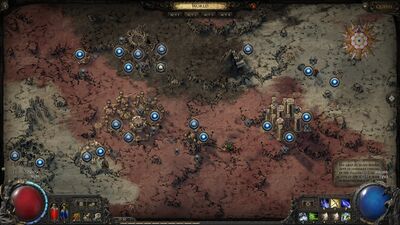
PoE2's endgame involves traversing across Wraeclast via the Atlas. The player makes progress on the Atlas by completing maps connected to your starting point and completed maps. Similar to how maps work in PoE1 after 3.28, the map's layout is selected on the Atlas itself and are opened using Waystones. Waystones can be crafted to determine the zone affixes and can be enhanced with Tablets to add additional encounters of their respective mechanic to the map, the number of which you can use on the map depending on the amount of modifiers on the waystone.
Maps on the Atlas can include special modifiers that can't be added by other items, such as making the map boss more powerful or adding an enhanced version of encounter mechanics.
After activating a nearby Precursor Tower, a massive Precursor Fortress will emerge. Maps within a Precursor Fortress can contain exclusive Precursor modifiers, and defeating the boss within them will grant one Atlas passive skill point. There is no limit to the amount of Atlas passive points you can acquire, allowing you to allocate every passive on the tree eventually.
League mechanics
Various league mechanics from PoE1 make a return in PoE2. Completing the pinnacle encounters for these mechanics will grant you skill points towards that league's Atlas passive sub-tree.
- Essences, Strongboxes, Shrines, and Rogue Exiles make a return.
- Corrupted areas causes slain monster to Coalesce Corruption, a mechanic that functions like Beyond.
- Azmeri spirits lead you to a Rare or Unique monster that gets empowered while buffing other monsters it touches, similar Tormented Spirits. They can drop Idols that can be socketed to gear.
- Breach: At first, only Unstable Breaches can be encountered randomly, but Breach Hives can appear randomly via Atlas passives. After collecting enough Breach Splinters from Breach monsters to form a Breachstone, it can be used to uncover a Breach Stronghold on the Atlas, containing maps overrun with the Hiveborn. Maps inside the Breach Stronghold contain Breach Hives, and Breach Fortresses going deeper into the center. At the stronghold's core awaits It That Was Tul and It That Was Esh, who hold the key used to fight the pinnacle boss Xesht, We That Are One. The Genesis Tree can be used to craft jewelry with exclusive mods and bases and currency items, including catalysts that can be used to add quality to jewelry and jewels. Breach RingsBreach RingRequires Level 40+20% to Maximum Quality now have increased maximum quality as an implicit and are not corrupted by default.
- Ritual: Rituals only offer unique items or omens. All remaining Tribute can be offered towards gaining An Audience with the King. Defeating the King in the Mists allows you to begin the Rite of the Nameless, which has you select 5 or 6 connected maps to add Ritual encounters to with additional rewards. Maps part of the Rite will always include a Ritual holding the map boss, and the final Ritual altar will summon all map bosses killed in previous Rites. Each map in the Rite rewards an effigy piece, where five of them can be used to access the pinnacle boss, The Bodach. Omens are the primary source of meta-crafting effects. They must be manually activated to be used.
- Delirium: A gauge will show how deep in the Delirium fog you are and when the encounter will end. Going deep into the fog you can find special mirror shards that can enhance monsters or add special encounters. Killing a map boss in a Delirium encounter has a chance to spawn a Grand Mirror at a nearby map, which duplicates the map boss. Defeating them will allow you to spread Delirium fog to multiple maps on the Atlas. Killing rare monsters and bosses within the fog makes all other fog covered maps more Delirious. At 100% Deliriousness, the player can encounter a Simulacrum. The Simulacrum is a 7-wave encounter. Completing it will grant a key to access a pinnacle boss encounter, The Raven Trickster. Liquid Emotions can be used to add an enchantment to amulets that allocates a passive skill the same way as Blight Oils did or add a crafted modifier to jewels.
- Expedition: An Expedition Logbook can be used to chart an Expedition across the ocean, revealing an area containing many islands. Additional logbooks can be used to explore more of the ocean. Verisium Remnants can be inscribed with runes that let you choose which modifiers to add to monsters in the explosion chain and the reward that drops from them. Expedition rewards include special runes, alloys, and fluxes for item crafting, components for Runeforging to add Runic Ward to armour or upgrade unique items, and Kalguuran skills and supports.
- Abyss: Abyss encounters involve defeating monsters spawned near fissures followed by defeating the pack of Abyss monsters that come out of the pits. Abyss monsters can have special monster modifiers and can interact with other mechanics. Abysses can drop preserved bones used to add a Desecrated modifier on an item, which can be revealed (unveiled) as one of three random modifiers.
Atlas passive tree
The Atlas Passive Tree consists of a main tree for general use, and sub-trees. The sub-trees grant specific bonuses towards boss encounters, league mechanics, and pinnacle content. Points towards the sub-trees are gained by engaging in that specific content.
In addition, the players can activate one of three Atlas Master specialisations for each map. By completing missions for Doryani, Jado, or Hilda, the player can unlock skills for their respective Atlas class. Only one of these specializations can be used for each map, but the player is free to swap between them at any time.
Pinnacle content
Inside the Precursor Fortress, The Burning Monolith guards the way into the inner sanctum. It requires keys dropped by endgame versions of the first three Act bosses to open, which leads to the pinnacle boss, The Arbiter of Ash. The Arbiter of Ash can be refought by acquiring the keys from Citadels that spawn throughout the Atlas. Beyond the Burning Monolith lies The Origin Tower, where by taking the Origin Core to the top, The Arbiter of Divinity can be fought. Each time you defeat the Arbiter of Divinity, a section of the Precursor Fortress can be activated to complete every map within that section and gain Atlas passive points from them.
Major encounter mechanics such as Delirium and Abyss have a questline attached to them, and after completing it and defeating its pinnacle boss, the player will be able to gain Atlas passives for its skill tree and increase their difficulty while unlocking new rewards.